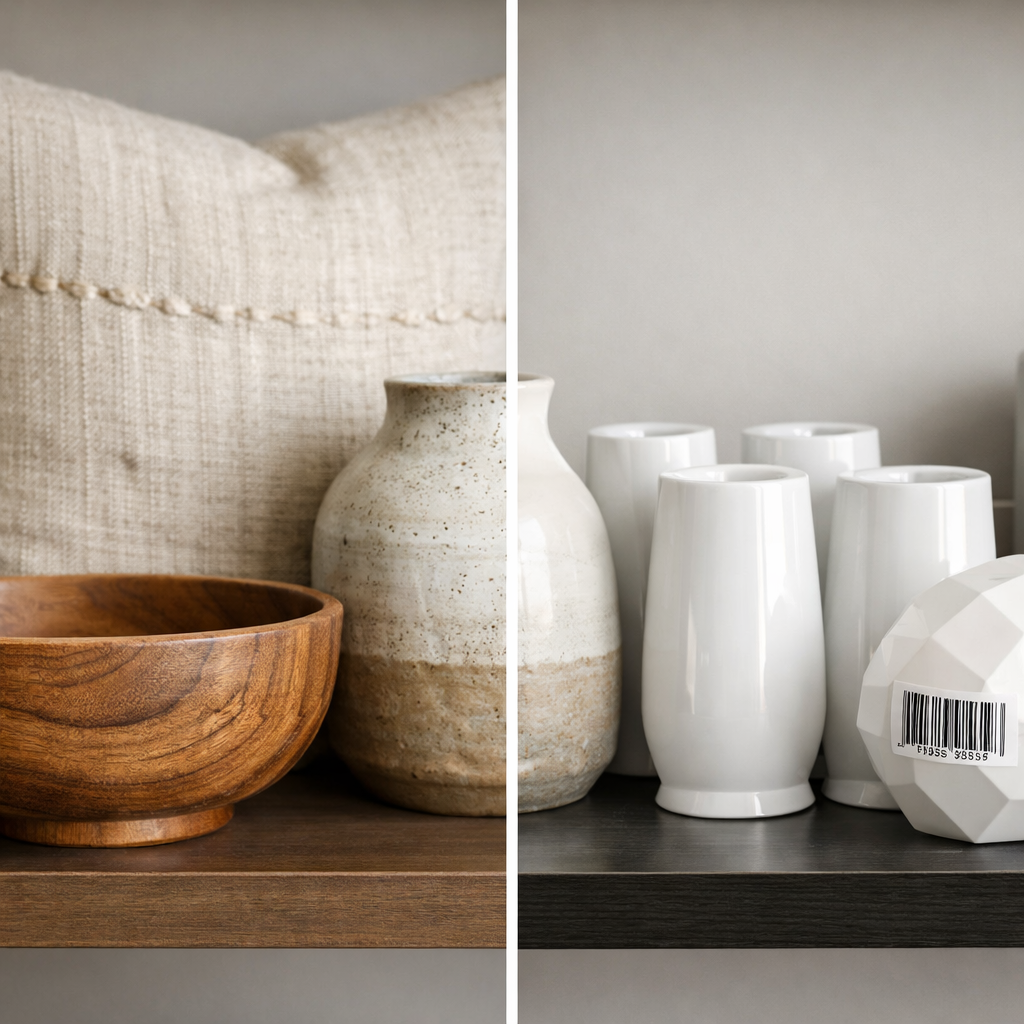
Handcrafted vs Mass-Produced: Which Decor Delivers Lasting Home Value?
A mindful home isn’t built overnight; it’s built piece by piece with an eye toward durability, repairability, and timeless design. When it comes to lasting home value, handcrafted decor typically wins for high-use, focal items because artisan-made construction, materials, and repair options extend lifespan and enjoyment. Mass-produced decor shines for speed, uniformity, and budget-friendly accents. The most resilient approach blends both: invest in a handful of “fewer, better” anchors and layer in replaceable accents as needs and tastes evolve. Below, we outline how to evaluate quality craftsmanship and total cost of ownership so your space feels grounded now—and ages gracefully over time. At The Yoga Republic, we practice this “fewer, better” approach to create calm, durable spaces that support daily rituals.
Overview of handcrafted and mass-produced decor
Handcrafted decor: “Handmade goods are crafted by skilled artisans using traditional techniques,” and each piece is inherently unique and personal in character, reflecting the maker’s touch and small-batch methods (see Handmade vs Mass-Produced: quality and value compared for context: https://www.luisabrimble.com/handmade-vs-mass-produced-goods-quality-and-value-compared/; and a perspective on uniqueness and SME impact: https://afomamarketplace.com/blogs/handmade-vs-mass-produced-impact-smes-online-marketplaces).
Mass-produced decor: “Items are made in large quantities using automated machinery,” prioritizing consistency and identical units at scale—a model where economies of scale lower the per-unit cost and accelerate availability (source: Handmade vs Mass-Produced: quality and value compared: https://www.luisabrimble.com/handmade-vs-mass-produced-goods-quality-and-value-compared/).
Core trade-off: Handcrafted offers uniqueness, customization, and provenance; mass-produced offers affordability, speed, and uniformity. Our lens is lasting home value—choosing durable home decor with quality craftsmanship, timeless design, and repairable, bespoke options where it matters most.
Criteria for evaluating lasting home value
“Lasting home value” means a decor item’s ability to deliver functional durability, sustained aesthetic appeal, and favorable resale or retained utility over its lifetime.
Use this checklist (score each 1–5):
- Material quality (species, fiber content, density, finishes)
- Craftsmanship (joinery, seams, hand-finishing, tolerances)
- Design longevity (timeless vs trend-led)
- Repairability (parts available, refinishing, modularity)
- Provenance/traceability (maker transparency)
- Sustainability metrics (materials, energy, waste, certifications)
- Availability/lead time (fit to project timeline)
- Price vs lifetime cost (maintenance and replacement)
- Resale potential (condition, maker reputation, limited editions)
Simple scoring table to compare options:
| Criteria | Score (1–5) | Notes |
|---|---|---|
| Material quality | ||
| Craftsmanship | ||
| Design longevity | ||
| Repairability | ||
| Provenance/traceability | ||
| Sustainability metrics | ||
| Availability/lead time | ||
| Price vs lifetime cost | ||
| Resale potential |
Signals that predict longevity: handmade goods often use higher-quality materials and allow customization; attention to detail in hand-crafted furniture improves durability; and production choices change environmental impact (see SME-focused insights on materials and customization: https://afomamarketplace.com/blogs/handmade-vs-mass-produced-impact-smes-online-marketplaces and discussion of craft furniture quality: https://navilluswoodworks.com/blog/hand-crafted-vs-mass-produced-furniture-understanding-quality-and-value/ and differences in environmental footprint: https://blog.artistrybazaar.com/differences-between-mass-produced-vs-handicraft-products/).
Material quality and build
Artisans commonly select premium, natural materials and build for longevity, not just speed—choices that you can see and feel in everyday use (an ethos emphasized by handmade advocates who highlight maker transparency and durability-first decisions: https://www.locallyhandmadene.com/blogs/locally-handmade-blog/why-handmade-products-win-over-mass-produced-goods?srsltid=AfmBOooiybY9d7pnuG1d_-Om3je9o3IILj_kBp8teVTnGcjKbzHyW0vg). We prioritize this feel-first quality in pieces meant for daily practice.
Build quality is the integrity of materials, joinery, and finishing that determines structural strength, wear resistance, and how gracefully an item ages.
Tangible quality markers:
- Solid wood vs veneer on MDF/particleboard
- Joinery: dovetail, mortise-and-tenon, dowel alignment; fewer visible fasteners
- Natural fibers (wool, linen, cotton) with dense weaves; well-fired ceramics
- Hand-finished edges and uniform stitching; no loose threads or gaps
- Weight/density appropriate to size; no wobble; even, low-VOC finishes
Design longevity and emotional resonance
Timeless design uses restrained forms, proportionate lines, and material-led details that remain relevant beyond trends—think quiet minimalism, honest materials, and classic silhouettes.
Handmade items often carry a story—buyers perceive authenticity in visible craft marks and maker narratives and are willing to pay for that resonance, which can preserve value over time (see why authenticity matters to buyers: https://www.locallyhandmadene.com/blogs/locally-handmade-blog/why-handmade-products-win-over-mass-produced-goods?srsltid=AfmBOooiybY9d7pnuG1d_-Om3je9o3IILj_kBp8teVTnGcjKbzHyW0vg).
Quick guide:
- Trend-led: ultra-saturated seasonal colors, novelty shapes, fast-fashion motifs
- Enduring: neutral palettes with warm woods, natural stone, vegetable-dyed textiles, classic stripes or solids, simple metal hardware
Tip: Choose neutral, material-forward anchors; update with small, trend-forward accents.
Repairability and lifecycle costs
Lifecycle cost is the total cost to own, maintain, repair, and eventually replace an item across its lifespan.
Handcrafted pieces are often designed to be serviceable—refinishing, part replacement, and maker repairs are common—because artisans’ reputations depend on durable outcomes. This can meaningfully reduce replacements and waste over time.
A simple lifecycle cost flow:
- Estimate expected lifespan (years).
- Map maintenance (cleaning, conditioning, refinishing).
- Rate repairability (1–5) and note likely repair costs.
- Forecast replacement timing (if any) within 10 years.
- Calculate projected 10-year cost: purchase + maintenance + repairs + replacements − likely resale.
Provenance, transparency, and sustainability
Provenance is the documented origin and journey of a product—who made it, with what materials, where, and how. Clear provenance supports ethical assurance and future resale.
Handmade purchases often trace directly to the individual maker, and customization is a core advantage; many artisans share shop details, sourcing, and process photos. Look for:
- Maker profile and contact details
- Material sourcing and certifications
- Production location and methods
- Repair/warranty terms and care instructions
- Batch or edition numbers for limited runs
These are the same signals we look for when selecting maker partners and studio objects.
Environmental footprint and waste
Environmental footprint is the total resource use and emissions from sourcing through production, transport, use, and end-of-life.
Industrial manufacturing can generate substantial waste and emissions, and in some contexts manufacturing and construction account for roughly a quarter of CO2 output (see a comparative overview of mass-produced vs handicraft impacts: https://blog.artistrybazaar.com/differences-between-mass-produced-vs-handicraft-products/). Many artisans, by contrast, operate at smaller scales, reduce offcuts, and choose recyclable or minimal packaging (noted by handmade-focused retailers: https://alexispaigecollection.com/blog/the-benefits-of-handmade-products-vs-mass-produced-goods).
Compact comparison:
| Factor | Handcrafted (small-batch) | Mass-produced (industrial) |
|---|---|---|
| Energy intensity | Lower per unit in small runs | High efficiency but energy-intensive at scale |
| Material waste | Maker-level optimization; fewer offcuts | Significant scrap/waste in high-volume lines |
| Packaging | Minimal/recyclable, often plastic-free | Standardized, often more protective packaging |
| Repairability | High; parts and refinishing common | Varies; many items designed as non-serviceable |
| End-of-life recyclability | Natural materials easier to recycle | Mixed materials complicate recycling |
Consistency, availability, and lead times
Mass production scales quickly for demand spikes and prioritizes speed and uniformity—useful when timelines are tight. Production modes, in brief (see the four production processes for manufacturing: https://www.cosmosourcing.com/blog/the-four-production-processes-for-manufacturing-pros-and-cons):
- Job production (handmade): one-off or bespoke; high customization, slower output, higher unit cost.
- Batch production: small-volume runs; balances flexibility with some efficiency.
- Continuous/mass production: standardized products; highest efficiency and consistent quality.
Timeline guidance:
- Order early: custom furniture, built-to-order lighting, made-to-measure curtains.
- Buy off-the-shelf: everyday accessories, basic frames, standard lampshades, storage bins.
Pricing and total cost of ownership
Handmade items usually cost more upfront because of labor intensity, premium materials, and the time and skill invested—especially in custom furniture (see a craft furniture perspective on quality and value: https://navilluswoodworks.com/blog/hand-crafted-vs-mass-produced-furniture-understanding-quality-and-value/). Mass-produced goods benefit from economies of scale that lower unit prices.
Total cost of ownership (TCO) = purchase price + maintenance + repairs + replacements − resale value.
Example (10-year horizon):
- Handmade stool: $400 purchase, lasts 15 years; maintenance ~$30. TCO ≈ $430 (no replacement needed within 10 years).
- Mass-produced stool: $150 purchase, lifespan ~4.5 years; 3 stools over 10 years = $450, plus ~$20 maintenance. TCO ≈ $470.
This TCO lens mirrors our “invest in anchors” philosophy.
Resale potential and perceived value
Uniqueness, provenance, and condition drive resale. Handmade pieces often hold perceived value because buyers pay for authenticity and story, and subtle craft marks can signal the maker’s hand. Document to preserve value:
- Maker details, receipts, and edition numbers
- Maintenance logs and any repairs
- Original finish and material specifications
- Photos of the item in good lighting to show condition
Limited editions, signed works, solid woods, and natural fibers tend to resell better. Highly uniform mass-produced items typically depreciate faster.
Side-by-side comparison by room and use case
Invest in handcrafted focal pieces; use mass-produced for fast-changing accents and utility.
Furniture and lighting
| Item type | Handcrafted best for | Mass-produced best for |
|---|---|---|
| Dining tables | Solid woods, classic profiles, repairable finishes | Budget tables for temporary spaces |
| Coffee tables | Joinery-led pieces that can be refinished | Simple, standard sizes for easy replacement |
| Bed frames | Sturdy hardwood frames with replaceable hardware | Metal frames for guest rooms or short-term setups |
| Statement pendants | Bespoke shades/metals sized to room proportions | Standard flush mounts for secondary rooms |
| Shelving | Built-ins or modular hardwood systems | Temporary, flat-pack units for rentals |
Hand-crafted furniture often shows superior attention to detail and quality control, which supports long-term value.
Textiles and soft goods
| Item type | Handcrafted best for | Mass-produced best for |
|---|---|---|
| Rugs | Heirloom, hand-knotted or flatweave natural fibers | Entry mats or high-traffic runners to replace as needed |
| Throws/blankets | Artisan, plant-dyed wool/cotton for warmth and longevity | Seasonal colors and patterns |
| Curtains | Natural-fiber, made-to-measure panels | Standard blackout liners or temporary shades |
| Bedding | Organic-fiber duvet covers and shams | Pillow inserts and protectors |
Natural, well-made textiles also align with The Yoga Republic’s preference for breathable, touch-friendly materials.
Art and statement pieces
| Item type | Handcrafted best for | Mass-produced best for |
|---|---|---|
| Original art | One-of-a-kind works with documented provenance | Large-format prints for budget staging |
| Ceramics | Studio-made vases, bowls, sculptural pieces | Basic planters and utility vessels |
| Limited prints | Numbered editions signed by the artist | Gallery wall frames and mats |
Each handmade piece is unique and reflects the artisan’s touch, enhancing authenticity and sentiment that can support value over time.
Everyday accessories
| Item type | Handcrafted best for | Mass-produced best for |
|---|---|---|
| Daily mugs/trays | Tactile ceramics and wood trays used in daily rituals | Office mugs, coasters, and extras for guests |
| Incense holders | Small ceramics with distinctive glazes | Basic tealight holders and utility baskets |
| Storage bowls | Turned wood or woven natural fiber | Stackable plastic/metal organizers |
When handcrafted decor delivers better long-term value
Choose handcrafted when:
- The item is a focal point or high-use (tables, bed frames, entry benches).
- Repairability, refinishing, and parts availability matter.
- Customization and precise fit elevate function and comfort.
- Provenance and story enhance daily enjoyment and potential resale.
- You prioritize smaller environmental footprints and traceable, ethical production.
Artisans often build for durability because reputation is on the line, and handmade goods typically carry less environmental burden than large-scale manufacturing.
When mass-produced decor makes practical sense
Mass production excels for standardized, high-volume needs and can rapidly meet demand spikes. Opt for mass-produced when:
- Timelines are tight (staging, moving, guest setup).
- You’re buying trend-led accents or items with high wear/loss.
- You need matching sets or uniform dimensions across multiples.
Trade-off: aggressive cost targets can reduce material quality and serviceability; inspect specs and finishes closely.
A balanced strategy for a mindful, high-value home
- Budget heuristic: allocate 60–70% to handcrafted anchors (tables, lighting, art) and 30–40% to mass-produced accents and utility items.
- Step-by-step:
- Assess needs by room and define daily rituals.
- Set a 10-year TCO budget.
- Choose handcrafted for long-life, repairable design where performance depends on material quality.
- Layer mass-produced pieces for flexibility and seasonal refreshes.
- Review environmental and provenance details to support sustainable decor and a mindful home.
How this aligns with The Yoga Republic’s ethos
We favor fewer, better pieces: organic materials, comfort-first functionality, durable construction, minimalist design, and transparent production. The same principles that guide studio-to-street apparel—breathable natural materials, refined silhouettes, and longevity over trend churn—translate directly to your home. Choose pieces that feel good in daily rituals, support repair over replacement, and age beautifully.
Frequently asked questions
Are handcrafted items worth the higher upfront cost?
Yes—if you value durability, uniqueness, and repairability; at The Yoga Republic we favor “fewer, better” pieces for that reason. Premium materials and careful workmanship extend lifespan and preserve enjoyment over time.
How can I verify that a decor piece is truly handmade?
Ask for maker details and process photos, look for subtle hand-finished marks, and review traceable provenance—these are the same cues we prioritize at The Yoga Republic. Transparent artisans disclose materials, methods, and workshop locations.
What materials indicate durable, long-lasting decor?
Solid woods, natural fibers, and well-fired ceramics are reliable, and mirror the natural materials we prefer at The Yoga Republic. Seek quality joinery, dense weaves, and finishes that can be repaired or refinished.
Do handcrafted pieces improve home resale appeal?
Select handcrafted focal pieces can elevate perceived quality and character for buyers—an effect we aim for in The Yoga Republic spaces. Keep provenance and care records to support future resale.
How do I balance artisan pieces with a realistic budget?
Invest in handcrafted anchors like a dining table or statement lighting—the Yoga Republic follows this mix—and use mass-produced accents for trend updates. Compare 10-year total cost of ownership before deciding.